



Quick Summary
Cycle parking is mandated to win planning approvals, with options including shelters, lockers, stands, racks, and ceiling-mounted systems. Each solution offers different benefits and is suited to specific project requirements, depending on available space, necessary security, and user needs. Head-Wind helps you avoid decision fatigue by site-engineering the right cycle storage solution for your exact project specs.
A Basic Bike Storage Solution Won't Help Your Project Much
If you are planning a construction project and need cycle parking to meet policy mandates, it might seem easier to just install the first option you find. But that isn’t always the smartest decision.
Yes, you’ll probably secure approval. But you could also end up with an option that doesn’t maximize your space, clashes with your architecture, leaves valuable BREEAM credits on the table, and frustrates eventual users.
After all, the right bike storage does far more than tick a compliance box. It complements your development, supports how cyclists use your building, and strengthens your sustainability credentials. In this guide, we’ll walk you through the best bike storage ideas for different types of projects so you can choose one that works for your space, your users, and your long-term objectives.
Why Trust Us?
Head-Wind is a trusted manufacturer and installer of bespoke cycling facilities, including bike storage systems. Some of our recent projects include Ireland’s first dedicated residential cycling hub at Cherry Lane and an integrated end-of-trip facility for Dún Laoghaire-Rathdown County Council.
”The team delivered exactly what was specified, on time and to a very high standard.
Amy Conway, Quantity SurveyorVision Contracting & Turkington Rock Developments
We have perfected the art of designing made-to-order cycling infrastructure that is functional yet compliant. This article leans on that expertise.
5 Bike Storage Ideas to Meet Cycle Parking Requirements in 2026
Here are five of the most effective bike storage ideas used across commercial, residential, educational, and public-sector construction projects.
1. Bike Shelters
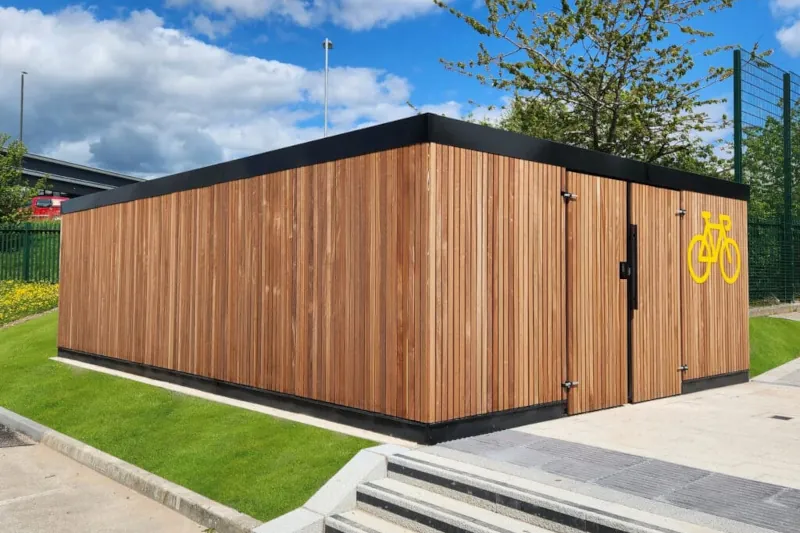
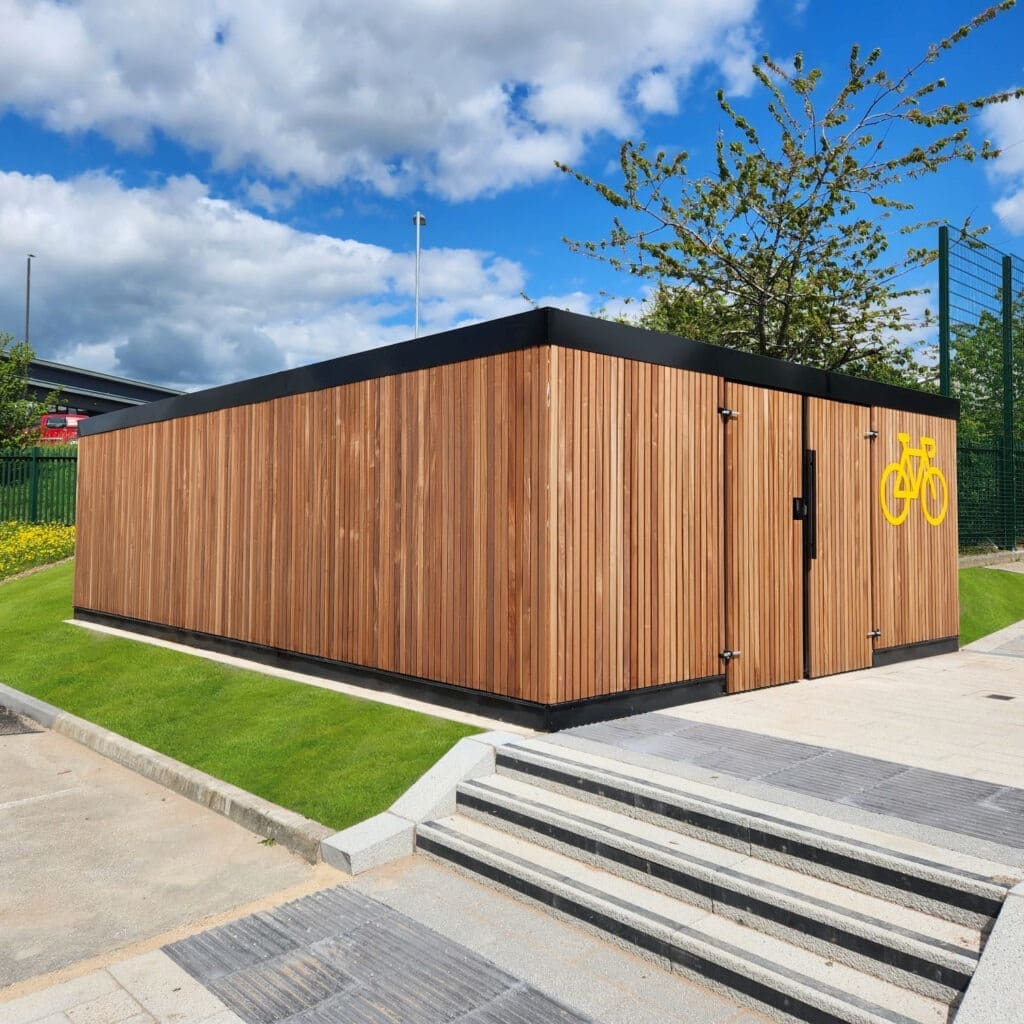
Bike shelters are covered cycle parking structures that protect bicycles from rain, snow, and prolonged sun exposure while keeping them easily accessible. They are one of the most widely specified cycle storage solutions because they combine good weather protection with high storage capacity and can be tailored to almost any development.
Depending on your project requirements, bike shelters are available in several configurations, including lean-to and canopy shelters, freestanding modular shelters, and secure cycle compounds with gated access.
Key Features and Benefits
- Provides high storage capacity
- Protects bicycles from the weather
- Encourages year-round cycling
- Can be combined with other cycle storage systems
Best Suited For
Bike shelters are often the preferred choice whenever a project needs to provide convenient, weather-protected cycle parking for a large number of users without sacrificing accessibility. For example, in transport interchanges and residential developments.
2. Bike Lockers or Enclosures
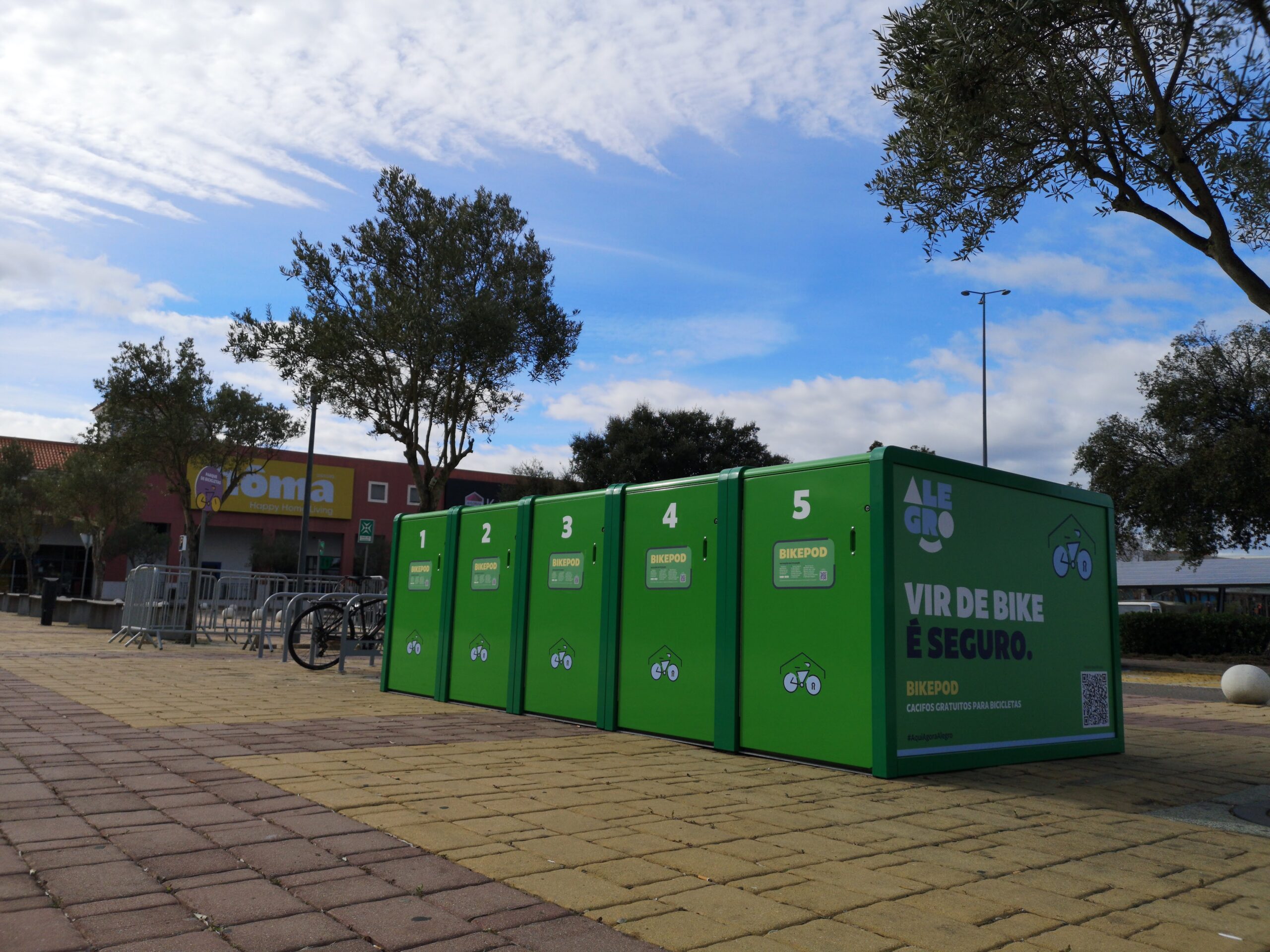
Bike lockers and enclosures provide the highest level of bicycle security. Unlike open parking solutions, they fully or partially enclose bicycles to protect them from harsh weather conditions. And unlike bike shelters, they store either an individual bike or at most two bikes, reducing the risk of theft or vandalism.
Key Features and Benefits
- Provides high storage capacity
- Protects bicycles from the weather
- Encourages year-round cycling
- Can be combined with other cycle storage systems
Best Suited For
Bike shelters are often the preferred choice whenever a project needs to provide convenient, weather-protected cycle parking for a large number of users without sacrificing accessibility. For example, in transport interchanges and residential developments.
3. Bike Stands
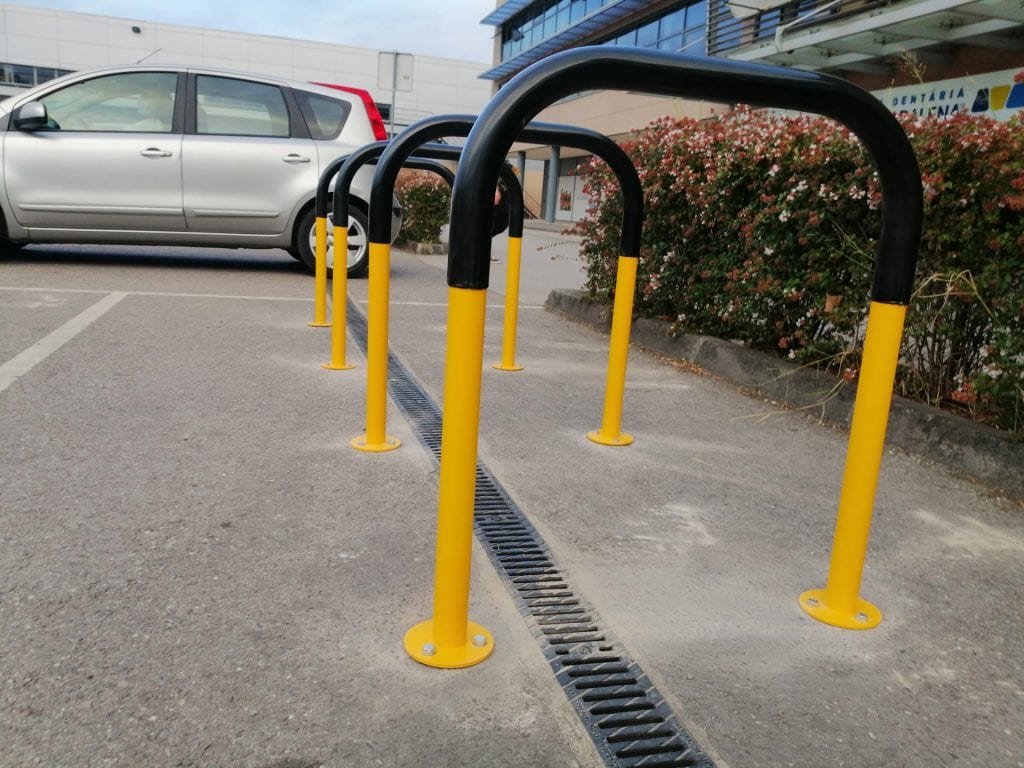
Bike stands are individual parking units that support one or two bicycles while providing a secure point to lock the frame. Bike stands are designed for convenient and easy to access bike storage, making them ideal for short-stay cycle parking.
Common options include Sheffield stands, bollard stands, wheel-grip stands, and freestanding floor stands. Among the different options available, Sheffield stands remain the industry-preferred choice because they allow cyclists to lock both the frame and the wheels securely while accommodating a wide range of bicycle types.
Key Features and Benefits
- Simple and intuitive to use
- Supports secure frame locking
- Suitable for high-turnover, short-stay parking
- Easy to install and maintain
- Available in a wide range of styles to complement different streetscapes and architectural schemes
Best Suited For
Bike stands work best where cyclists need quick, convenient parking rather than long-term storage. They’re particularly suited to developments with frequent visitor traffic, where easy access is more important than maximizing storage capacity. So, they are perfect for retail and shopping centers, public plazas, civic spaces, etc.
4. Bike Racks
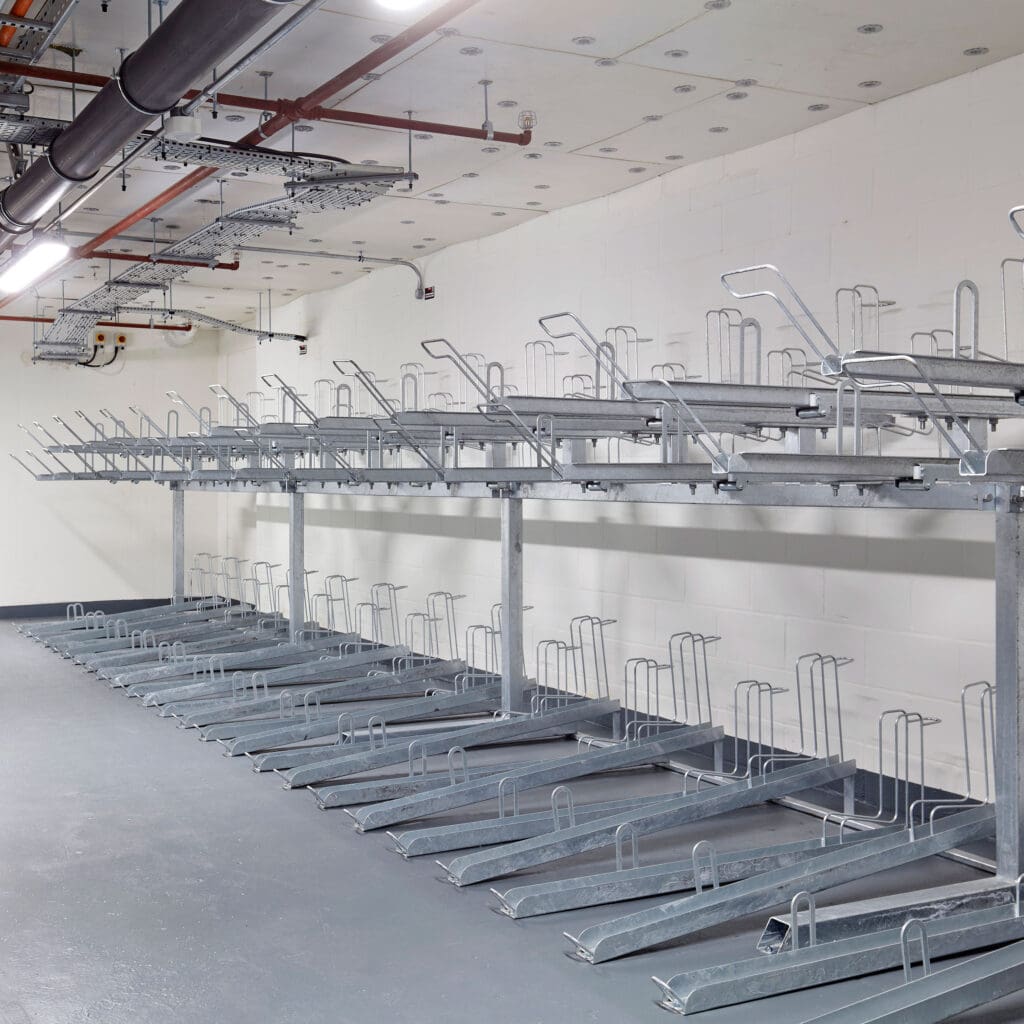
Bike racks are commonly used in projects where space efficiency is crucial. Cycle racks are designed to increase storage density without increasing the space footprint, making them ideal for low- to medium-capacity environments where space must be well managed.
Depending on the specification, bike racks are typically grouped into three main categories: two-tier racks, vertical racks, and semi-vertical racks. Each serves a different spatial and user requirement.
Two-Tier Bike Racks
Two-tier bike racks are high-density systems that stack bicycles on two levels—one at ground level and one raised above it using a guided lifting mechanism. This design effectively doubles parking capacity within the same footprint, making it one of the most space-efficient solutions available for modern developments.
Most systems use a gas-assisted lifting rail on the upper tier to reduce user effort, allowing cyclists to load bikes without needing to manually lift the full weight. This significantly increases usability.
Vertical Bike Racks
Vertical bike racks store bicycles upright by the front wheel, using a wall-mounted or freestanding system to maximize vertical space. They can efficiently increase capacity in tight footprints, particularly where floor space is limited, but ceiling height allows upward storage.
While highly space-efficient, vertical systems require users to lift the bike into position, which can make them less suitable for heavier bicycles or users with limited physical ability.
Semi Vertical Bike Racks
Semi-vertical racks store bicycles at an angle rather than fully upright, using a trough or wheel-guided system to support the bike. This reduces floor space requirements while avoiding the full overhead lift required in vertical systems.
They are often used in controlled environments like basements, where ceiling height rules out full two-tier systems.
Key Features and Benefits
- High-density storage within compact floor areas
- Efficient use of vertical space in constrained layouts
- Flexible for both retrofit and new-build installations
- Works with a wide range of bicycle types when correctly specified
- Scalable across small and medium-capacity developments
Best Suited For
Bike rack systems are best suited where cycle storage needs to be efficient, structured, and space-optimized, without requiring full enclosure or individual security units. Typical applications include retrofit cycle rooms, residential apartment basements, etc.
Design the Right Bike Storage Solution With Head-Wind
In most construction projects, there isn’t a single “best” bike storage option. Different systems are often combined for a more integrated cycle parking strategy. For example, a residential basement might include two-tier racks for capacity, lockers for security, and ceiling-mounted systems to utilize otherwise unused space.
But deciding which storage options best fit your space constraints and cycle parking obligations is where things become more complex. And that stage is where it becomes beneficial to consult a custom cycle storage specialist like Head-Wind.
We take the confusion off your plate by assessing your project requirements, spatial layout, compliance needs, and user profile, then translating them into a coordinated cycle storage design that actually works in practice.
Instead of managing multiple systems and suppliers, you get a single, integrated solution—designed, manufactured, and installed to fit your building properly, meet compliance obligations, and support long-term usability.
Get in touch to learn how we can help you meet your cycle parking needs with minimal stress.